
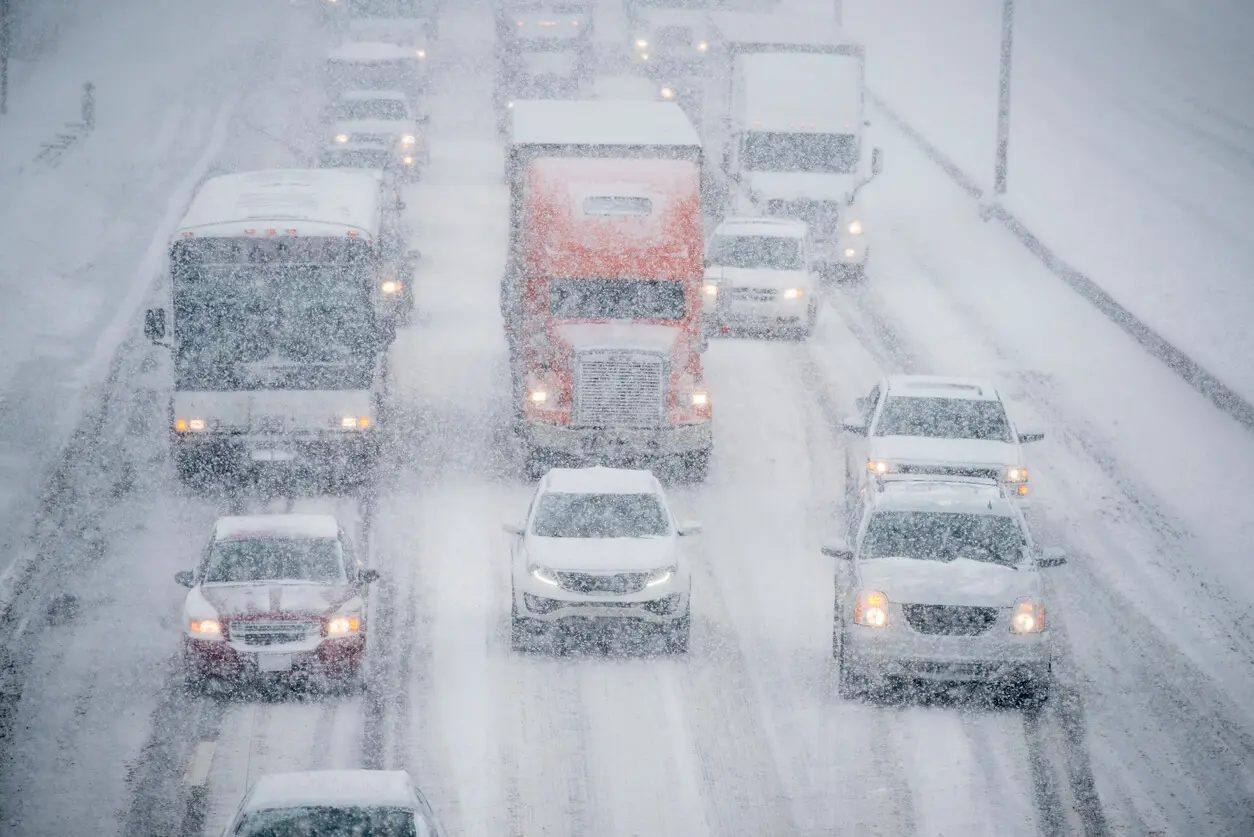
It is no surprise that winter is the most dangerous season for Canadian motorists. In fact, more than 37 per cent of car accidents in this country occur in months of ice and snow, according to a recent report by Samsara, a U.S.-based fleet management system that uses artificial intelligence to anticipate road risks.
“Canada’s winter landscape creates a driving environment unlike anywhere else in North America. Snowpack, freeze–thaw cycles, and below-freezing temperatures combine with steady year-round freight and municipal operations,” says Kelly Soderlund, Samsara's head of insights.
Samsara examined “anonymized data from commercial fleets across Canada between 2022 and 2025, covering billions of kilometres driven on highways, suburban corridors, and urban arterials.”
“The findings show that winter is Canada’s peak season for both driving and danger. Unlike in warmer regions where fleets reduce exposure during winter, Canadian operations continue at scale—and every kilometre becomes more hazardous,” according to Soderlund.
Of course, every motorist in Canada is aware of the hazards of driving at the time of year: whiteouts, blowing snow, high winds, reduced traction, black ice and freezing rain. In Southern Ontario seasoned drivers have also become accustomed to warm spells, rain and thaws that refreeze overnight.
There are also some roadways that are more hazardous than others and more than half of the most dangerous winter roads in Canada are here in this province.
Hit Hard by January Storms.
If we needed a reminder of the hazards of winter driving, we received it in January. A high-impact snowstorm swept across Southern Ontario midmonth where some Greater Toronto Area (GTA) neighbourhoods saw more than 30 cm of snow accumulate in a relatively short period of time.
The storm caused the usual travel issues, school closures, business disruptions and hundreds of motor vehicle accidents.
Ontario Provincial Police reported that vehicles were “pinballing off each other,” on treacherous roadways.
“Most are single-vehicle crashes, cars in the ditch, into guardrails, facing the wrong way after losing control,” said OPP Sgt. Kerry Schmidt in a report published by Global News. “We’ve also had a couple of multi-vehicle crashes.”
We barely got a chance to clean up from that before being pummelled by a second major storm at the end of the month which dumped nearly 60 centimetres of snow on parts of the GTA. Of course, we still have a long way to go before warmer weather returns.
Our Roads Are Safe But…
According to the RCMP, nearly 30 per cent of collisions reported to the National Collision Database in 2017 occurred on wet, snowy or icy roads with one third taking place from November to February.
Single-vehicle collisions were most common in early winter with Canadian insurance providers reporting a 49 per cent increase in collision-related claims in December and January, the RCMP states.
While accidents will always be a concern in the winter, Canadian Automobile Association (CAA) spokesperson Nadia Matos told CBC News that she believes Ontario highways are among the safest in North America.
"Perhaps we do have more collisions in the wintertime when people are hustling and bustling to get to their loved ones, but I think it's important not to lose sight of the fact that our highways in Ontario are still pretty safe," Matos said.
Top 10 Most Dangerous Winter Roads.
According to the Samsara study, “Canada’s winter crash risk isn’t evenly spread across its road network—it concentrates in specific geographic zones where weather, terrain, traffic mix, and wildlife movement collide.”
“These hotspots tend to cluster around mountain passes with steep grades, lake-effect snow belts, forested wildlife corridors, major freight interchanges, and dense suburban logistics zones,” the report notes.
Samsara’s top 10 most dangerous winter roads in Canada include six from Ontario:
- Erieau Road – Erieau Peninsula lakeshore (Ont.) Lake-effect snow, narrow two-lane geometry, and shoreline curves between Chatham-Kent and Erieau.
- Trans-Canada Hwy. – Rogers Pass and Yoho National Park (BC) Steep grades, avalanche exposure, and tight curves between Golden, Rogers Pass, and Lake Louise.
- Trans-Canada Hwy. – Banff–Lake Louise (AB/BC border) Heavy tourist and freight mix, wildlife crossings, and frequent snow squalls.
- Yellowhead Hwy. – Jasper–Hinton corridor (AB) Elk and moose crossings, forested curves, and fast-changing mountain weather.
- Yellowhead Hwy. – McBride–Tête Jaune Cache (BC) Narrow, mountain valley, grade changes, and patchy traction.
- Hwy.17 – Kenora–Dryden (Ont.) Long, dark two-lane stretches through dense moose habitat, with limited passing and shoulders.
- Hwy. 11 – Hearst–Kapuskasing (Ont.) Extreme cold, limited lighting, and wildlife movement along remote boreal forest segments.
- Queen Elizabeth Way – Burlington Skyway (Ont.) Crosswinds, elevated structure over Hamilton Harbour, and heavy truck volumes.
- Hwy. 401 – Mississauga interchange complex (Ont.) 401/403/410 interchange zone with dense freight traffic, frequent lane changes, and winter refreeze on ramps.
- Hwy. 401 Express/Collectors – Toronto core (Ont.) Collector–express weave between Pearson International Airport and Scarborough with high density, spray, and rapid refreeze on overpasses.
Exercise Caution Behind the Wheel.
You may not be able to avoid driving on one of Canada’s most dangerous winter roads but there are steps you can take that can reduce your chances of being in an accident. Preparation, especially in winter, can go a long way to keeping you safe. The Ontario Government suggests keeping your vehicle well-maintained to face the elements.
Make sure your fuel tank is at least half full. Have an ice-scraper and top up your car with washer fluid that works below -40C.
Keep a winter survival kit in your vehicle that includes a charged phone, water and non-perishable food, a flashlight, a shovel, traction mats or sand, a blanket and warm clothes, booster cables, candles and a lighter or matches.
No matter the weather or driving conditions, speeding increases your chances of being in a collision so police suggest slowing down and be prepared to adjust to unfavourable driving conditions.
Plan your trip, check for weather alerts and road conditions, clear your car of any ice or snow and give yourself plenty of time to get to your destination. Consider canceling or rescheduling your outing in extreme weather conditions.
Be alert and well-rested and avoid distractions such as your cellphone. Keep a safe distance from the vehicle in front of you. Give large trucks and snowplows a wide berth.
Avoid quick acceleration, hard braking or a sudden, jerking movement of the steering wheel that can cause you to skid. If that happens take your foot off the brake and steer in the direction you want to go while being careful not to oversteer. Another suggestion is to avoid using overdrive or cruise control.
Call Us if You Have Been Injured in an Accident.
Accidents happen and the force of a collision can cause injury, disability or death. A winter crash can leave you dealing with car repairs, insurance calls, and injuries all at once. Many of these crashes are single-vehicle, but you may still be entitled to accident benefits regardless of fault.
If you have been hurt in a car accident, our team of experienced personal injury lawyers has the expertise to handle the most challenging and complex cases. Contact us so we can plan your next steps.
Expertise.
Share
Subscribe to our Newsletter