
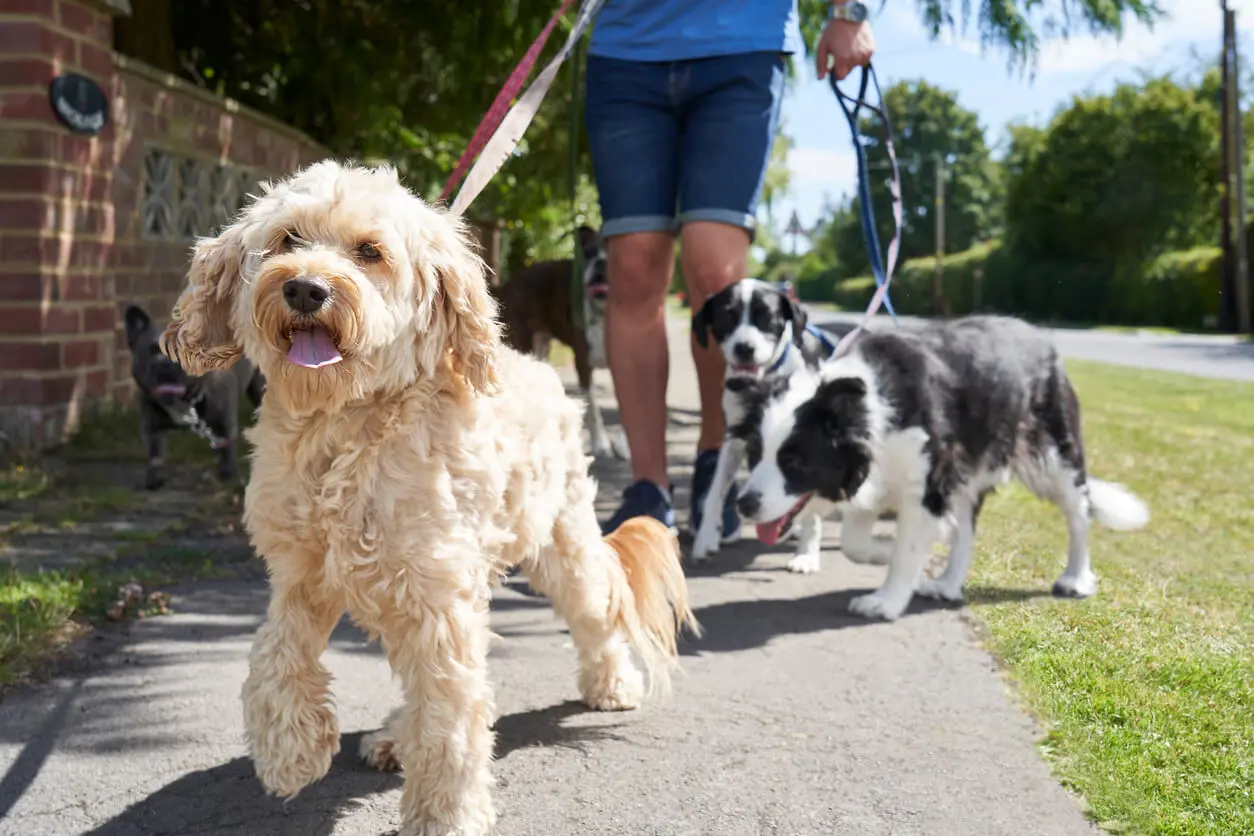
Becoming a dog walker for hire has several advantages, in addition to the obvious financial benefits. It is an opportunity to get outdoors, get some exercise and build a connection with the community. Dog walkers can be students or retirees seeking to earn some extra income, or entrepreneurs looking to build a full-time career.
Walking a canine also has mental health benefits. According to Psychology Today, “being around a dog can lower levels of the stress hormone cortisol and dampen other physiological stress responses.”
“If you’re a dog lover, spending time with your pet can be a powerful antidote to stress,” according to the report. “The effect is so strong that service dogs are sometimes used to help war veterans manage PTSD. Know what else is a proven stress reliever? Physical activity. When you combine these two things in dog walking, you’ve got a double-strength stress remedy.”
However, those hoping to boost their income by offering their services as a dog walker need to be aware of the risks and obligations that go along with the job.
Dog Bites Are Not Uncommon.
Of course any dog can bite, and for a variety of reasons. It is not necessarily the breed that influences whether a dog will bite, but their individual history and behaviour, states the American Kennel Club (AKC).
“With very rare exceptions, dog bites do not come out of nowhere, even if it sometimes seems that way. From small nicks that don’t break the skin to serious bites that require medical care, there are multiple reasons a dog might feel that biting is their best response,” according to the AKC. “Unfortunately, people often miss the warning signs that a bite could happen. Most dogs will try to communicate discomfort prior to biting by barking, growling, or snapping at the air.”
Most people injured by dogs are familiar with the pet. In fact, some research indicates that up to 90 per cent of dog bites are inflicted by an animal the person knows. The victim can be a family member, a friend, a neighbour or even a dog walker.
It is important to understand that any dog can bite under certain circumstances. There are reportedly about 500,000 dog bites in Canada each year, with children the most likely victims. And the injuries can be severe and traumatizing, requiring not only immediate medical attention but follow-up care including plastic surgery, therapy and counselling. A fear of dogs can also develop following such an encounter.
Who Is Responsible When a Dog Bites?
It would be natural to assume that if you are bitten by a dog and suffer a serious injury, the animal’s owner would be liable for damages. In many instances, that assumption would be correct, but the law is complex and cases turn on their specific facts.
Recently, the Ontario Court of Appeal (OCA) held that a part-time dog walker who was bitten by one of the dogs she was caring for could not sue her clients (the dog owners) for damages because she was considered to have been the “owner” of the animal at the time of the incident.
According to a CBC News report, the woman was bitten as she tried to put rubber boots on “Forrest Gump”, a boxer, as she was preparing to let the dog go outside in November 2021. The woman, who cared for her clients’ two dogs about three times a week, was told that Forrest would need to wear booties to protect an infected paw from the elements.
“As she approached Forrest with the booties in one hand, the dog lunged at her, bit into her left arm and started shaking it. After the dog walker managed to get her arm loose, Forrest continued to attack her, biting her on various parts of her body. She sustained injuries to her abdomen, left upper thigh, and both arms,” according to the OCA judgment.
The woman sued her clients for $1 million while Forrest Gump’s owners countered that they could not be held liable because under Ontario's Dog Owners’ Liability Act (DOLA), the woman technically “owned” that dog at the moment she was bitten. The Court of Appeal agreed with a lower court decision to dismiss the claim, stating that pursuant to s. 1(1) of the DOLA, the lower court judge observed that the term “owner”, when used in relation to a dog, includes a person who “possesses or harbours the dog”. The OCA concluded that “there can be no doubt that the appellant (dog walker) was an owner of Forrest for purposes of the DOLA.”
“The appellant was the sole person in the company of the dogs at the time of the incident,” according to the judgment. “She was employed by the respondents and had attended at the house to care for the dogs three times a week. She had been in possession of the dogs on prior occasions, just as she was in possession of them on the day of the incident … she was unquestionably the person in a position to control the behaviour of the dogs at the critical time.” This seems like a harsh result, however it is quite consistent with the language and scheme of the DOLA.
Understanding the Dog Owners' Liability Act.
Dog owners in Ontario are generally responsible for injuries caused by their pets. Even if your dog has never harmed anyone before, the dog owner can still be held strictly liable under DOLA. In earlier times, it was axiomatic that unless the owner had prior knowledge of the biting propensity of the dog, liability could not be made out. Thus, it came to be known that every dog was entitled to one free bite. The DOLA changed that, such that unlike a claim for injuries arising from a car accident or a slip and fall, the injured party in a dog bite case does not have to prove negligence on the part of the dog owner, or knowledge of the dog’s propensities. Indeed, liability will not be precluded even where reasonable steps were taken by the owner to prevent an attack.
However, someone trespassing or committing a crime when bitten or attacked may face challenges in advancing a claim “unless the keeping of the dog on the premises was unreasonable for the purpose of the protection of persons or property.”
What is also significant, as illustrated in the Court of Appeal judgment referenced earlier, is that “ownership” of a dog can extend to those who are temporarily responsible for the pet, such as a dog walker.
As well, even if a dog bites or attacks someone on private property, the liability of the owner is determined by the Dog Owners’ Liability Act; not under the Occupiers’ Liability Act. The latter Act holds property occupiers responsible for injuries to visitors caused by unsafe conditions or activities on private premises; however, its application is expressly excluded by section 3 of that Act where a dog bites or attacks someone on private premises.
If you provoke a canine or fail to obtain permission from the owner to interact with it, for example, you may still be entitled to damages if you are injured, but any award may be reduced to reflect your own contribution to the event’s occurrence.
We Will Advocate For You.
The law is complicated, and making assumptions about your case can be counter-productive. You may be entitled to damages not only for pain, suffering and disfigurement, but also for economic losses, including lost wages, and future care needs.
At Gluckstein Lawyers, we can assess your claim and answer any questions you may have. Our personal injury lawyers will work with you to maximize the compensation you are owed to support the physical, emotional, and mental trauma caused by a dog bite or attack. Your initial meeting is free and without obligation on your part, and we will never charge you legal fees until your claim is settled. Contact us today.