
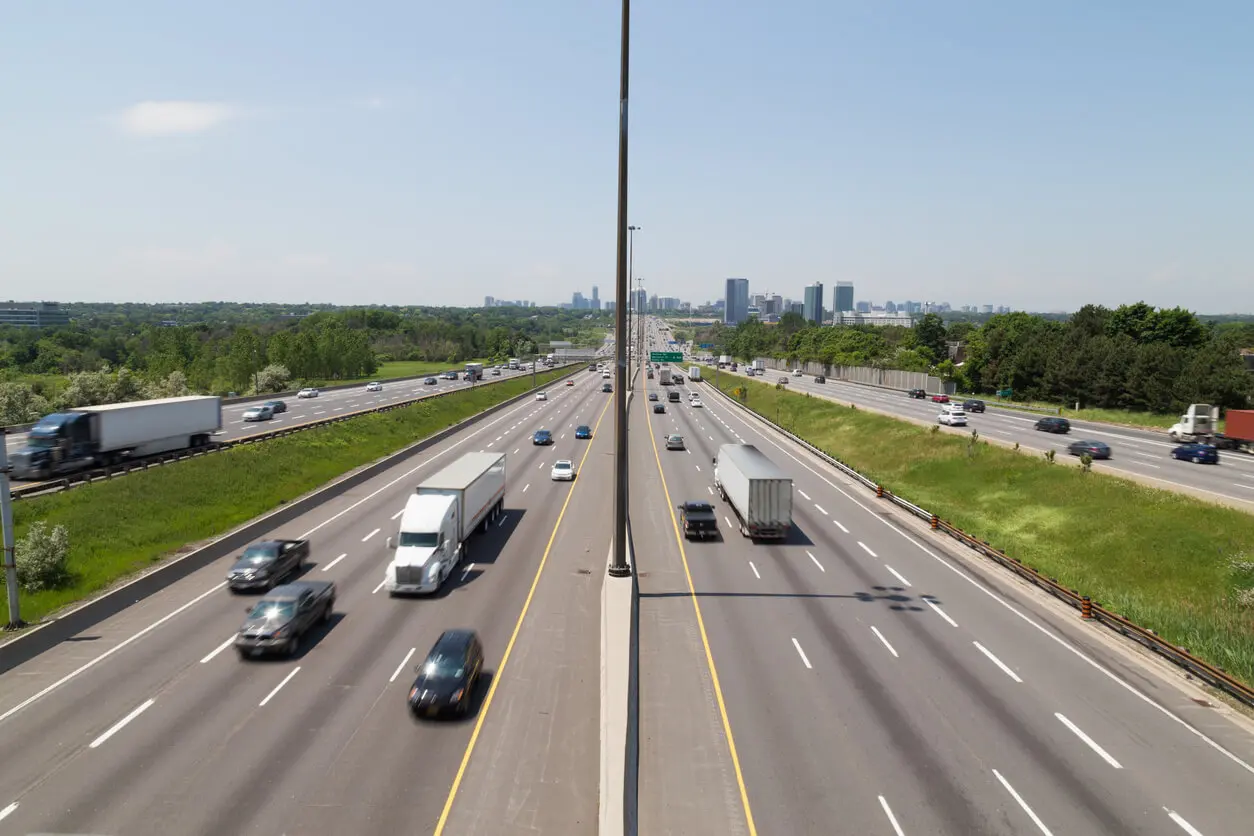
This summer, the speed limit on sections of Highways 401 and 416 in eastern Ontario was increased to 110 km/h, followed by sections on other highways, including the QEW and Highways 400, 401, 402, 403, 416 and 417. By the end of September 2026, nearly 89 per cent of Ontario’s highway network will have a posted speed limit of 110 km/hour.
‘Rigorous Technical Reviews’
“Speed limit increases are only implemented on highways that have been designed and engineered to safely accommodate higher speeds, following rigorous technical reviews and any necessary infrastructure improvements,” The Ford government announced in June. “Most of Ontario’s freeway network was originally designed to safely accommodate a posted speed of 110 km/hour.”
Ontario’s Ministry of Transportation (MOT) notes that this province’s roads have ranked among the safest in North America for the past 25 years, with one of the lowest fatality rates per 10,000 licensed drivers.
The MOT also states that it has been monitoring the highways where the speed limit was previously raised and found that “the operating speeds and collision trends within these sections have remained comparable to other similar highway sections where speed limits remained unchanged at 100 km/h.”
Going forward, all newly constructed highways, including Highways 413, 425 (Bradford Bypass), 7 (Kitchener to Guelph) and 69, will be designed with a posted speed limit of 110 km/hour.
Opinions Are Split.
The government says those who responded to an online survey before the rollout were overwhelmingly in favour of change.
Some believed the government didn’t go far enough. Stop100.ca founder Chris Klimek, stated speed limits should be increased to 120 km/h on all metropolitan 400-series highways (with the exception of hazardous stretches, such as sharp turns) and 130 km/h on all 400-series highways outside metropolitan areas.
“We have state-of-the-art highways. It’s a travesty we’re not letting people use the highways the way they have been intended to be used,” he told the Ottawa Citizen. “Engineers designed these highways to be perfectly safe to drive at 120.”
Klimek told the newspaper that people typically drive at a speed they feel safe with, which is typically about 120 km/h on well-designed, four-lane highways.
However, some safety advocates have concerns. Chatham-Kent councillor Alysson Storey told CBC News “higher speed limits are proven to reduce reaction time.”
“Whenever you reduce reaction time at a high rate of speed, mistakes can happen, driver error can happen, there's less time to react to it,” she said earlier this summer.
Mohamed Hussein, an associate professor with the McMaster department of Civil Engineering, says faster speed limits come with consequences:
“Most people believe that they can drive at faster speed limits with no problems. But when you increase your speed, you are putting yourself at an elevated risk of collision,” he stated in a 2024 report. “I can say with 100 per cent confidence that increasing the speed limit will increase the number of fatal collisions on the road. There is a famous study from the University of British Columbia in 2016 that assessed B.C.’s decision to increase the speed limit on some highways. The study showed an 11 per cent increase in fatal collisions after increasing the speed limit, after controlling for all variables.”
Hussein also maintained that increasing speed limits will have negative impacts for the environment.
“The transportation sector is one of the major contributors to greenhouse gas emissions and climate change. Increasing speed is associated with higher energy consumption, higher emissions, and higher noise levels,” he said.
Speeding Has Consequences.
According to a recent report by the World Health Organization (WHO), approximately 1.16 million people die each year as a result of a road traffic crashes, and 20 to 50 million suffer non-fatal injuries, with many incurring a disability.
WHO states that an increase in “average speed is directly related both to the likelihood of a crash occurring and to the severity of the consequences of the crash.”
“For example, every one per cent increase in mean speed produces a four per cent increase in the fatal crash risk and a three per cent increase in the serious crash risk,” the report noted. “In car-to-car side impacts, the fatality risk for car occupants is 85 per cent at 65 km/h.”
The United States’ National Highway Traffic Safety Administration notes that driving at excessive speeds can result in:
- Greater potential for loss of vehicle control.
- Reduced effectiveness of occupant protection equipment.
- Increased stopping distance after the driver perceives a danger.
- Increased degree of crash severity leading to more severe injuries.
- Economic implications of a speed-related crash.
Safety advocates also note there are drivers who routinely push the envelope when it comes to posted speed limits.
“Let’s be frank here, people are already driving over the speed limit,” Franca Palkowski, co-founder of the Caledon Community Road Safety Advocacy Group, told Global News. “You’re travelling with traffic on the 401, let’s say, you’re going 120, no problem, that’s the regular speed. And if people are comfortable going 20 over, going to 110, are we now going to be comfortable going 130, 140?”
The MOT also acknowledges ‘the faster you drive, the higher your risk of losing control and being involved in a crash, which can be fatal or cause serious injury.”
“The risk of fatality or serious injury is 11 times higher in collisions at 50 kilometres per hour or more over a speed limit of 100 kilometres per hour, than when vehicles are involved in a collision while driving at, or below, the posted limit,” according to the government. “The laws of physics behind speeding affect everyone the same way. Speeding increases braking and stopping distances. It also reduces your field of vision, which makes it harder to react quickly to changing road conditions.”
We Can Help.
A collision at any speed can result in devastating and long-lasting injuries or even death. Whether you are a driver or passenger involved in a crash, or a pedestrian or cyclist struck by a vehicle, it is in your best interest to seek advice from experienced legal professionals.
Contact the personal injury team at Gluckstein Lawyers for a free consultation. We will listen to your story, explore your options, explain our fee structure, and determine how we can represent you and help you access benefits and compensation for your losses.